
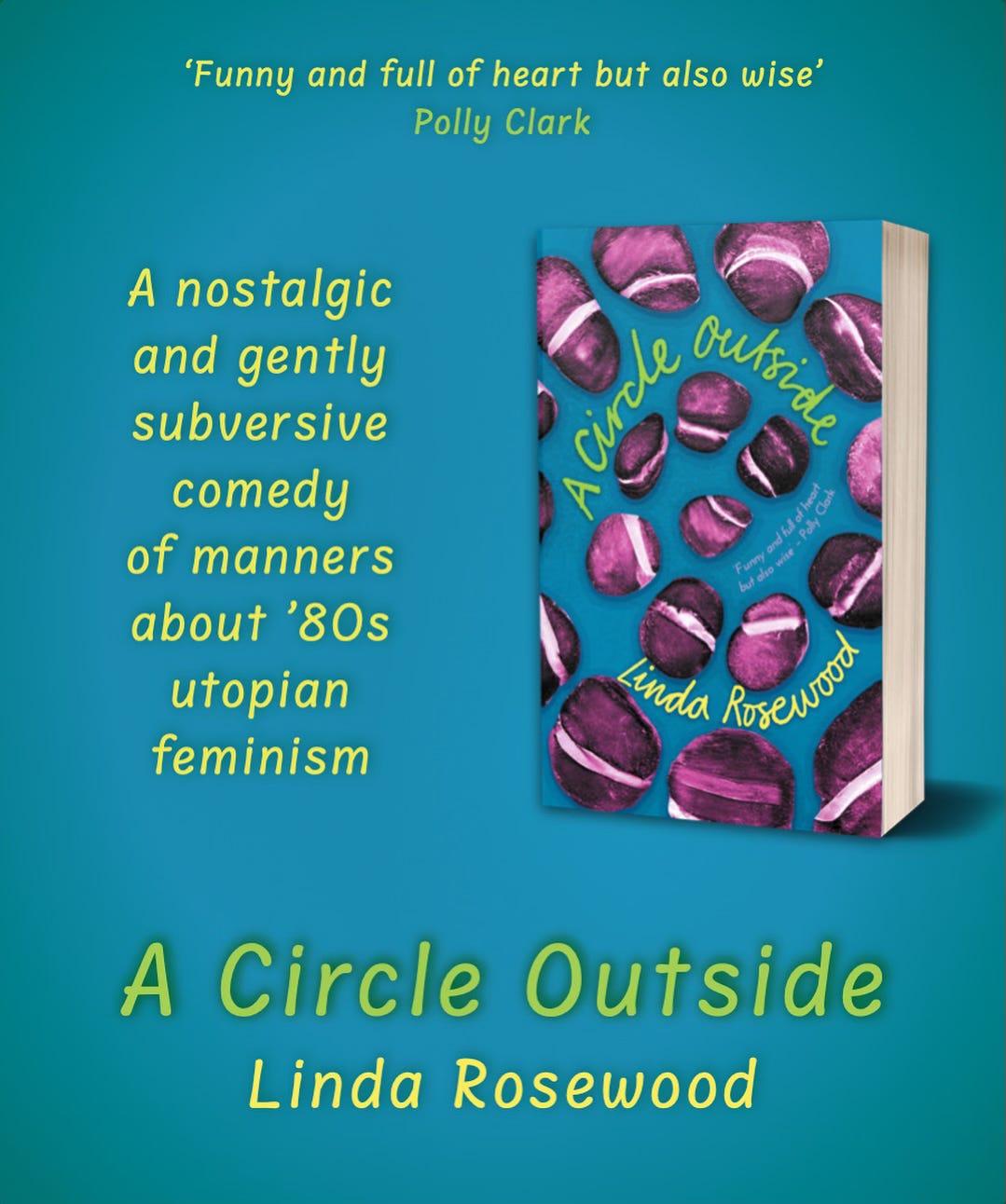
In the 1980s, I loved reading women-only utopias like Daughters of the Coral Dawn, The Wanderground, Motherlines, and The Demeter Flower. I liked how these books began, but halfway through, the main conflict was always the arrival of men who disturbed the perfect world created by women.
Since then, I wanted to write a women’s utopia novel where the conflict came from the women themselves. Women are stronger together when we can argue effectively. I learned this from feminist philosopher Donna Haraway. I audited one of her courses, and remember nothing from it except that she said in her ideal women’s utopia, women would argue all the time. This idea took hold in me. A group of women accustomed to (nonviolent) conflict would learn to resolve it, and learn to identify when a conflict is so divisive the group can’t stay together. They know how to break up and reform without destroying either faction. In the book I eventually wrote, A Circle Outside, the characters use real-world conflict resolution methods to resolve conflicts, large and small.
The characters in A Circle Outside are witches. In the 1980s when I was doing rituals like those in my book, we were inspired by Z Budapest’s The Holy Book of Women’s Mysteries. Z’s book taught Dianic witchcraft, which means only women and goddesses are present at rituals.
Some of us took classes from Z or women she trained, and met in small groups of women, no more than a dozen. There we created rituals, which we described to ourselves as “sacred play.” We celebrated the seasons and their metaphors, made wishes to heal ourselves and the world, and learned to create imaginary landscapes together where we could speak to goddesses, travel to distant lands, or create magical objects with symbolic relevance.
I believed in the supernatural at the time. I was raised Catholic, so speaking to a statue of a saintly intercessor fit inside my worldview. Because I am a book nerd, knowledge systems that claimed ancient wisdom were also attractive to me, like astrology and tarot. I believed, mostly because I wanted it all to be true.
As I grew older, I came to see that the supernatural aspects of Dianic witchcraft were not real. On the other hand, its poetic, psychological, and sociological aspects are powerful technologies. They develop the skill of effecting women-centered changes yourself and how you approach the people and situations of life. So I wrote a book about a group of Dianic witches receiving the benefits of doing magic with other women. I didn’t want to write a book about supernatural witches; the world has too many of those books already.
The characters in the book are lesbian feminists. Some women come to feminism through loving women, but I did not. When I experienced the feminist awakening, I was not yet a lesbian. The moment my eyes were opened to the suffering of women at the hands of men, and the absolute ocean of women-hating we were all swimming in, filled me with rage and resolve.
A few years later I followed my sexual desire into women’s bedrooms, and learned how loving women sexually, and loving women politically, are inextricable. So from then on, lesbian feminism became my approach to how I see the world.
Finally, the characters in the book use psychedelics in ritual. After decades of prohibition, we are in a time when people are returning to the therapeutic uses of psychedelic medicines. I wanted to show how these medicines can be used intentionally. Psychedelics allow for encounters with archetypes, and ordinary objects can become sacred. With sufficient openness and experience, ritual use of psychedelics can effect self-transformation, which is the only real magic.
Thematically, the book is about how eventually you learn that the thing you hate about yourself is probably your greatest strength. It’s about what to do when you have Bad Ideas about yourself.
And that is what my psychedelic lesbian feminist pagan utopia novel is about.