[A post from my old blog, June 2019]
Our friend Hilary visited from Santa Cruz. She and I spent a few days in Sligo. She'd never been there before. The first day we visited passage tombs, went to the movies, and listened to the music at a pub.
The second day Hilary and I got up early to visit Sligo wells, and as we were packing up the room, I noticed my wallet was missing. I searched the car, and it wasn't there. I retraced my steps and Hilary remembered I had used my card at the cinema when we watched "Us." (Great movie; filmed in Santa Cruz.) Then I remembered that before we went out, I stood in the room looking at my cards deciding between taking just my cards or my whole wallet, and I took my wallet because I was afraid I'd lose the cards without it.
So I must have lost my wallet at the cinema or at Thomas Connolly's pub.
"Did you lose it at the pub?" our host Mary asked. (Another reason why you should stay at BnB’s and not AirBnBs.)
"No, I don't think so," I said, because I paid for the drinks in cash out of my pocket. So it was probably at the cinema. She said if someone found it on the street, they would turn it in to the Garda station at the end of the road. So don't worry. We should go out on our Sligo holy well adventure and she would call Thomas Connolly's and the cinema when they opened.
So off we went. My main worry was losing my immigration card which would be extremely bureaucratic to replace.
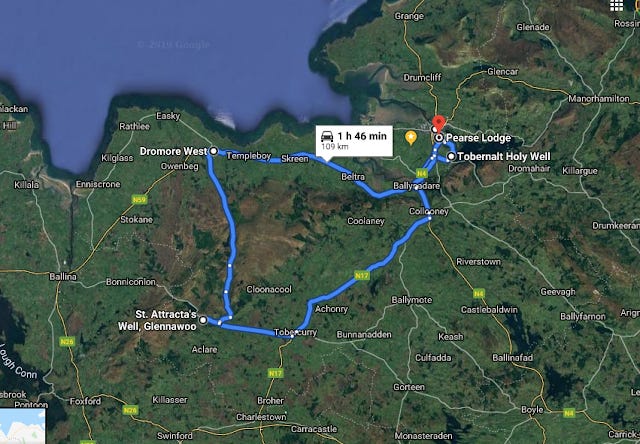
First, we went to Tobernalt, just outside Sligo town. Megalithic Ireland has good photos and this video:
This description the Schools Collection shows it is not much changed in the last 80 years.
Tobernalt
This is a few miles outside the town. The altar is always neat, clean, decorated with flowers; candles are always burning there.
Mass is said there on Garland Sunday. Boatloads of people attend it. The water in the well is said to be nicer and clearer than any well in Sligo. I have drunk this water and it is most refreshing. There are cups there for the people. Numbers bring home water in bottles. (Schools Collection)
One change from the old days are the two prominent signs forbidding drinking of the water, which means people must be drinking the water all the time. At most holy wells, you find old coffee mugs for your sips, or plastic bottles for taking the water home to cure the sick. Some wells have a ladle attached with a chain. Taking a "sup" of water is often part of the ritual (the "turas").
Because Tubernalt is so much like a church and populated, we didn't take photos. We did sit close to the rushing water below the well, and I asked if maybe my wallet might be returned.
The next well on our list was St. Attracta's Holy Well. This is not St. Attracta's Well of Lough Gara near Ballaghaderreen in Co. Mayo. That well is elaborate and contains carvings and cursing stones and other attractions. Stories about this holy well concern the pagan daughter of a king who didn't want to get married. She fled her home, found St. Patrick, and the usual piety ensued. (Here's a tale about that St. Attracta.)
The St. Attracta's holy well we visited is the one in Glenavo, Kilmactigue. We had GPS coordinates, so naturally we drove back and forth along a highway until we came to a lake which meant we had gone too far.
Eventually the directions, coordinates, and a map took us up a private lane and into a farm yard. Uh oh.
"Hello, how are you?" I greeted the farmer, identifying myself with my accent.
"I'm all right," he said.
"Is there a holy well around here?"
"Yes, I'll show you."
He led me to the field in front of the farmhouse, tapped the electric fence to make sure it was off, and directed us to walk across the field, apologizing for the sheep muck. I thanked him and said we came for the sheep muck too. He laughed and said people visit all the time and it was no bother.
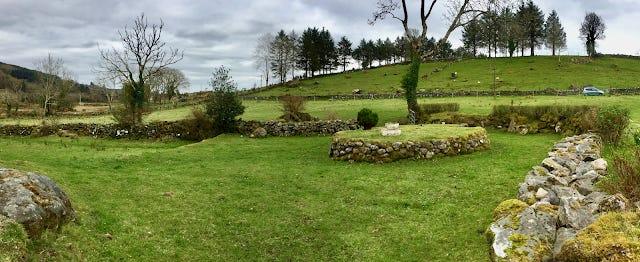
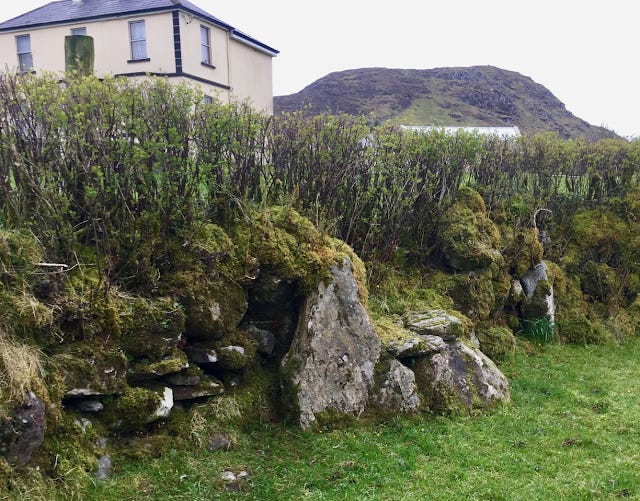
Saint Attracta's Well
Once upon a time there was a monster out at Glenavoo who used to go around devouring the cattle and crops of the place, all the people were afraid of it until Saint Attracta came and chased him down a hill and put him into a hole and blessed a well that was there. She then gave the water to the people to sprinkle on their crops and homes and that no harm would come to them. Glenavoo is a townland in the parish of Kilmacteige in County Sligo. Stations are performed there every year on the last Sunday of July. (Schools Collection)
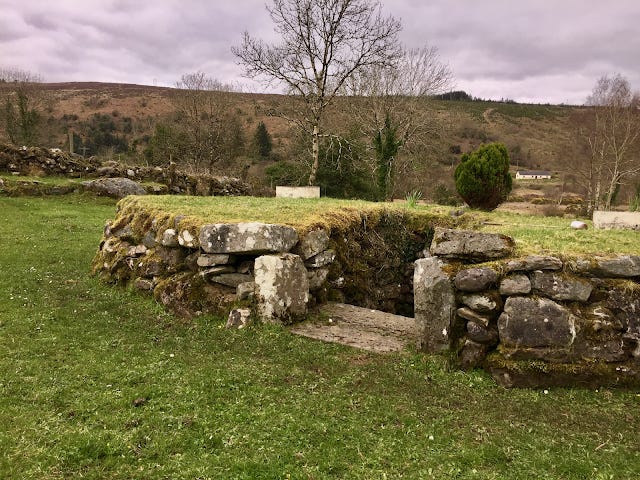
Saint Attracta's Well
Saint Attracta's well is situated at the foot of the Ox mountains. It is about four miles from this school. Glenavoo is the name of the village where Saint Attracta's well is located. This is how the well got its name. Long ago, there lived in Glenavoo a large monster. This monster lived in a big hole in a hill. The name of the hill is brumas. Every day he went about from place to place killing animals and birds. Often and Often he killed the people themselves. However, there lived in Glenavoo at that time a little girl named Attracta. This little girl was very pious. She spent most of her time in prayer. One day as she was walking in the fields she met the great monster. She did not run away in fear like the other people but she stood up in front of the monster. He attacked her and they began to fight. After a long and fierce battle Attracta killed the monster.
In the very spot where she killed him a beautiful spring well sprang up. It is the very same well that is there today. That is how Saint Attracta's well got its name. In the months of July and August many people go on pilgrimages to Saint Attracta's well and they pray to the famous saint there. (Schools Collection)
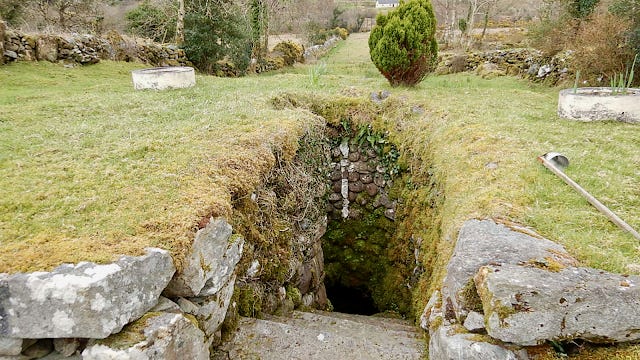
In the photo above, you can see the stick and can that serves as a ladle. They still observe the old ways here, regardless of muck.
I asked if maybe my wallet might be returned.
We were hungry, so we stopped at the little lake we met earlier and ate cheese, chips, and peanuts in the car. We were on an adventure with no time to faff around at a diner.
The next well was in Dromore, about 40 minutes away. We took more than an hour to get there.
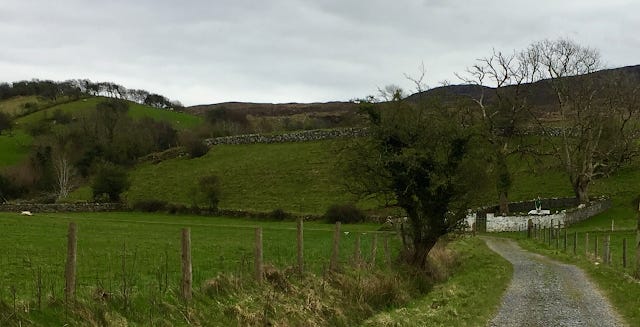
From the N59, about 8.5 miles east of Dromore West, turn right at the sign for Dromard Roman Catholic Church, at the Fiddler's Elbow Public house. Follow this road for 1.8 miles and then follow the signs for the well and cemetery. Just past the cemetery is a field gate with whitewashed pillars and a wall. The well is in there. Sacred Ireland
Eventually, these instructions made sense, and we parked at the cemetery. When I pulled my coat off the back seat, I noticed my wallet was under it. Of course. With one more well on the list where to give my thanks.
I called Mary to tell her she didn't need to keep asking people to look for my wallet. Connelly's already had, and she was getting ready to go to the Cinema herself to ask after it, so I'm glad I called right away.
Before we walked to the cinema, I chose to take the wallet with me. I used a debit card there, so how did my wallet end up in the car? You try to explain it because I can't.
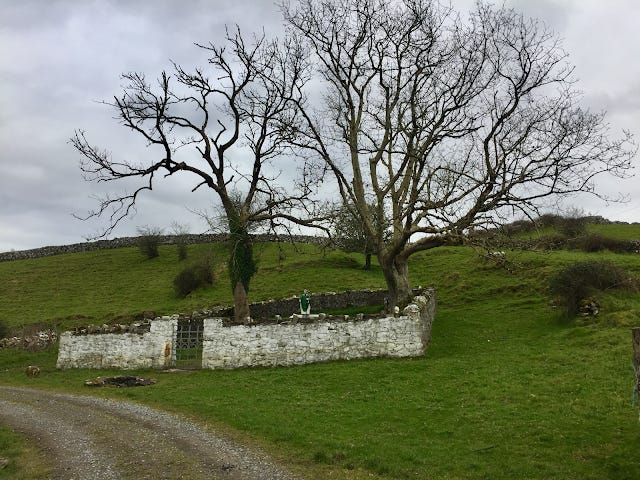
This is said to be the oldest well in Connacht. There is a local tradition that water from this well was taken to consecrate all the holy wells in Ireland. Sacred Ireland
Take a look at that photo and remember that holy wells almost always have their sacred trees as well. Christians placed their first churches next to sacred trees, and even today where there is an abbey ruin, for instance, there is usually a holy well.
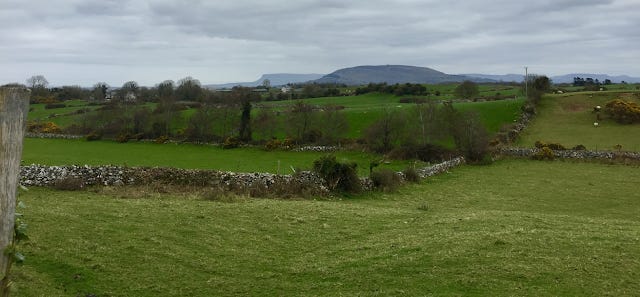
Dromore is west and a little south of Sligo town, and from the holy well you can see both Knocknarea and Benbulben, the two great sacred mountains of Sligo. Most sacred sites in this part of Sligo have a view of Knocknarea, but only from this side part of the country would you be able to see both.
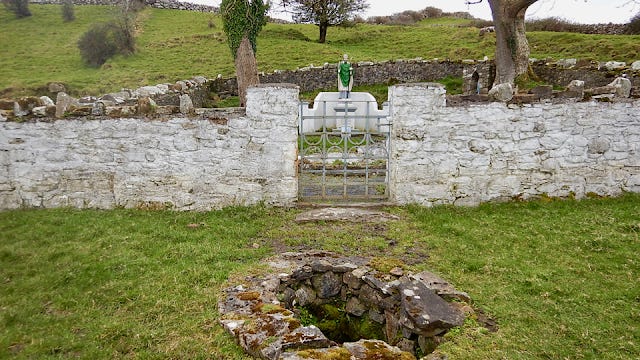
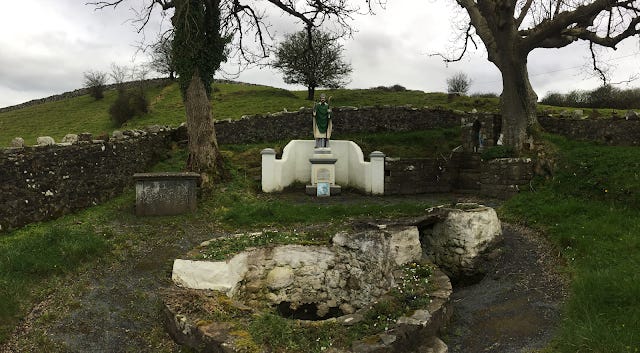
The "round well" is on the left, open to the sky. "Bridget's flag" is on the right.
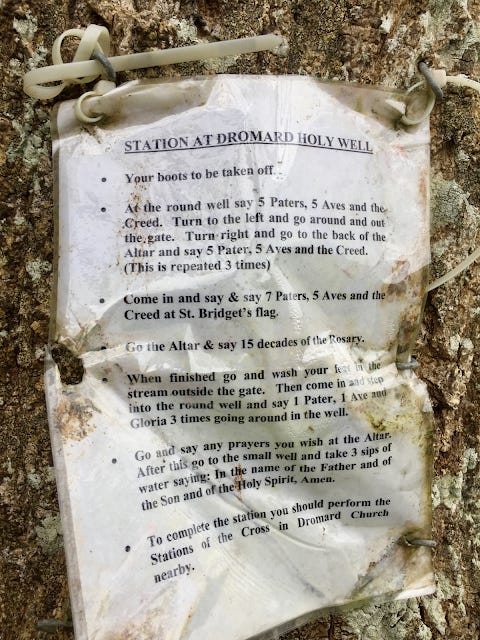
Most wells have a particular turas, and this one is more elaborate than others. It would take more than an hour to complete, not including the stations of the cross afterward.
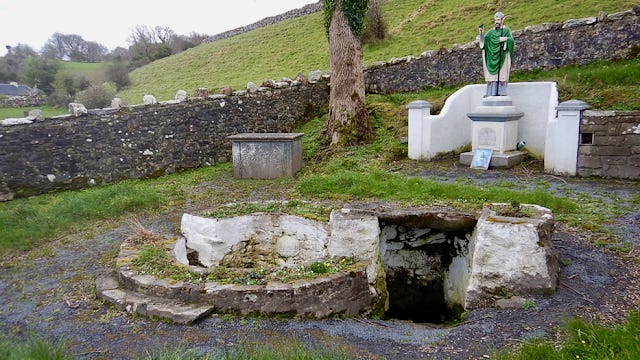
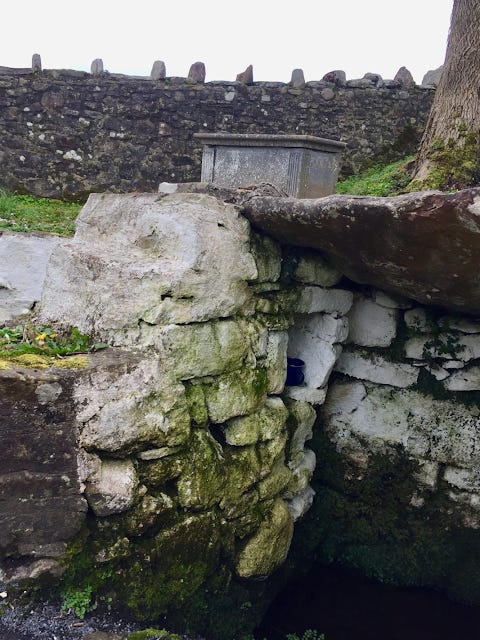
We spent a good long time here, as it is a peaceful, beautiful corner of the world. Plus, I was grateful.