
There is a story recounted by Mary Condren in her book “The Serpent and The Goddess” which links Lassair to St. Brigid in a curious way. The story is that St. Brigid came to visit St. Lassair, and so Lassair slaughtered her last ewe in order to provide food for the saint. During the meal, however, St. Patrick then dropped by. Lassair had no more to offer the new guest (presumably both clerics had brought full retinues), and Lassair was at risk of breaking the laws of hospitality. Brigid shared her portion so that Lassair would not lose face, and in gratitude, Lassair gave Brigid her church (of women) and her flock of sheep. Condren reads into this a passing on of the following of a local female figure to the stronger, national figure of Brigi; a handing-on of the flame, or the mantle, to keep practices of female spirituality alive in an increasingly male church.
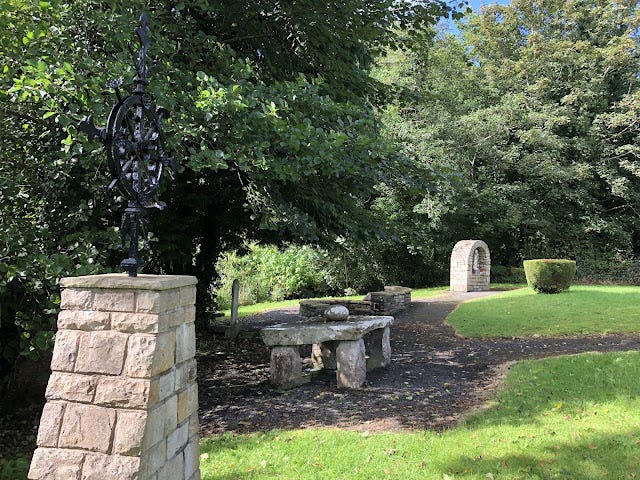
This is a lovely spot, well signed, with wide roads and easy parking. The photo above shows the cross, the altar table and stone, and a shrine to Our Lady. The wall around the well is visible just beyond the table.
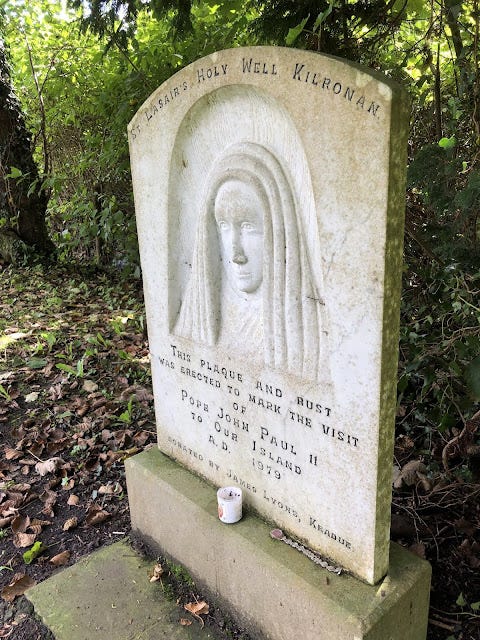
What you can’t see is this bust of St. Lassiter herself, a commemoration of the visit of the pope.
At wells with elaborate folklore rites you’ll often find a soggy notice from the Bishop—like you do at St Lassair’s—telling you how to use the shrine. This one describes circlings of shrine, well, altar, and cross, ending with thanksgiving for one’s own baptism and contemplation everlasting life in the graveyard on the hill above the shrine. (The Dead there share the sacred ground with a shrine to O’Carolan, the harpist. When I visited his grave, I was able to play a recording of his music from my phone. I’m still amazed by technology sometimes.)
I stood in front of the shrine to Our Lady, covered in rosaries and Majugoria bracelets. There was a 50 c coin and a euro coin near her feet.
I took the euro off the altar and put it in my pocket.
I swear, she told me to.
Then I went to the well. I forgot to take a picture of it, and it probably would be disappointing, as photos of wells usually are. It was filled with clear water, suitable for magic of all kinds. The only odd thing was a 4-inch plastic dashboard-Jesus in a red robe standing on the rim. He’s not there any more.
I swear, she told me to.
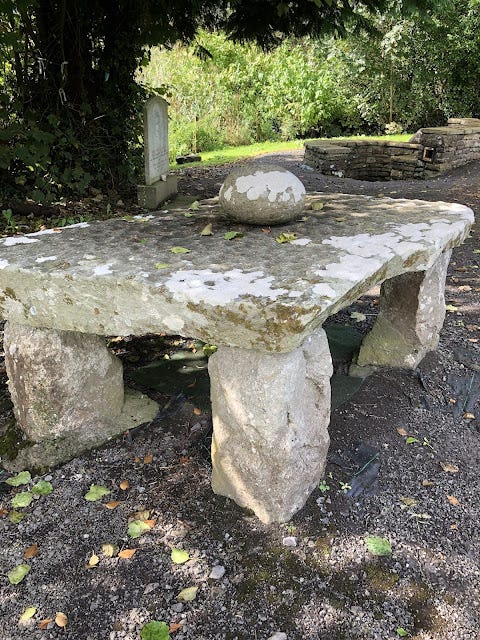
Next, I walked to the altar table. Folklore says if you crawl under it three times, it cures backache.
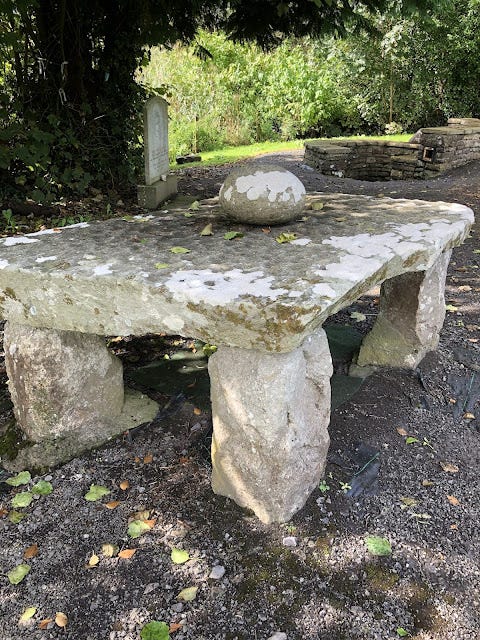
The top of the altar is pitted as if covered in Neolithic cup marks, and I’ve read that the stone probably once covered a neolithic grave.
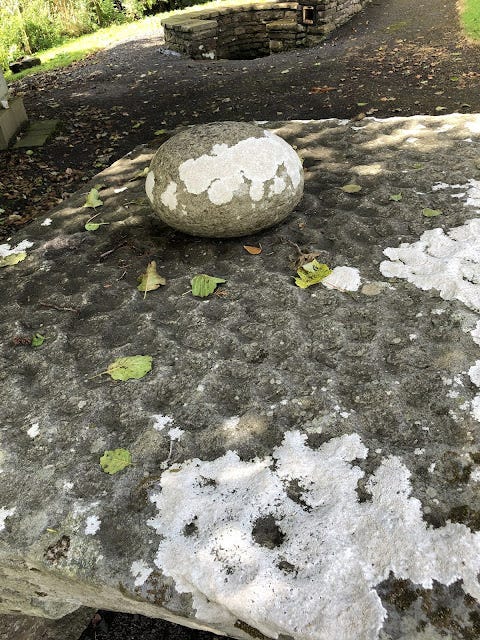
I have met a few cursing stones on my travels. It’s a simple ritual: turn the stone to the right to bless, and turn the stone to the left to curse.
I turned the stone to the right for my wife, and then again for all my friends in Ireland and America.
Since I was there, I thought I might as well curse my enemy. But do I have an enemy?
No.
What about an enemy of the world we live in?
The Saint reminded me of the coin in my pocket. She wanted to get in on the curse of our enemy. So I tucked it under the stone.
If that curse is working, then the blessing is too, and I’m sure you’re already feeling it.