
The Ague Well for Everybody
A well without a saint
This essay was published in Pagan Ireland, an excellent quarterly magazine that is available as a pdf so you can subscribe from anywhere in the world.
Not too far from our house near Creeslough, Co. Donegal is the Auge Well. “Auge” is a word that came into English from French, so I suppose you pronounce it “ah-gew.” It means malaria, and refers to its sharp and cyclical “acute” fever. If it has an Irish name, I haven’t found it yet. Besides the obscure name, the well doesn’t have a saint associated with it.
I’m interested in malaria because many years ago I read a scary book called The Mosquito, A Human History of our Deadliest Predator, by Timothy C. Winegard. (He also has a recent book about horses which I want to read.)
The horror of Winegard’s book stuck with me because of the incalculable suffering malaria inflicted. History would be very different without malaria. Even our bodies would be different. We evolved blood diseases that confer resistance to the malaria plasmodium; sickle cell anemia being only one of them.
Some researchers see evidence that malaria arrived in Ireland with the Mesolithic farmers who brought the cows. Maybe it arrived after extensive contact with the Romano-British. We know for sure the disease really got bad 400 years ago, when thousands of immigrants arrived seeking the health and prosperity that eluded them in their home country.
England’s colonization began in earnest in 1585. Seventy years later, the English civil war resulted in rule by Lord Protector Oliver Cromwell. Ireland suffers from the immense destruction and sectarian culture of the Cromwellian conquest to this day.
But here’s where malaria comes into the story.
Cromwell was sick with malaria for nine years before he died. In Cromwell’s day, malaria was treated with an early form of quinine, powered bark from the cinchona tree. Cromwell refused because quinine was brought to Europe as a malaria cure by Catholic Jesuits.
Because of malaria and his religious convictions, Cromwell didn’t live long enough to establish a viable successor. If he had been healthy, the monarchy may have never been restored. Instead, under Charles II, the political and economic power of the Ascendency began.
For the next two hundred years, Ireland experienced a real-life Scouring of the Shire. The plantation system developed Ireland’s natural resources into industries: textiles, agriculture, mining, fisheries, shipbuilding.
This is where malaria comes in again. The planters introduced a labor force from among the farmers of the England’s southeastern fenlands, a region where malaria had long been endemic. In addition to the political regulation of workers’ lives by a state religion, these immigrants were promised a new life in a healthier country.
But 80,000 thousand English farmers brought their malaria infections and malaria-infected cattle with them.

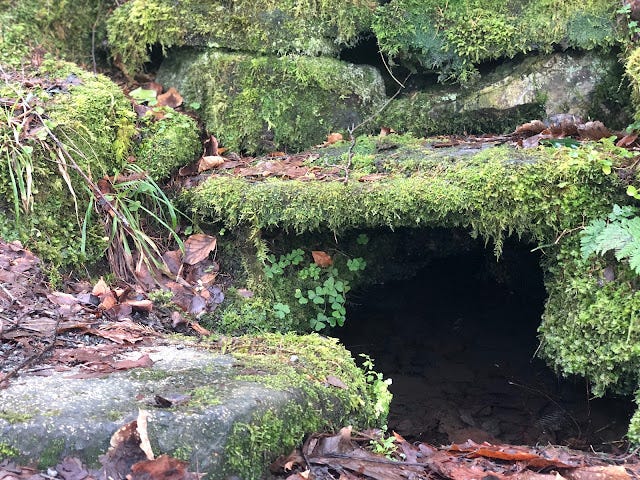
I wonder if the Ague Well in Creeslough was so designated at the time of Plantation of Ulster four hundred years ago. That would explain why it has that particular cure, but not a saint. At that time, while some Irish people emigrated, some remained, perhaps as crypto-Catholics, as evidenced by the mass rocks in the neighborhood. Regardless of their faith or family, ancestors of my neighbors suffered from displacement, immigration, and malaria. Anyone could visit this beautiful well, and take what comfort they could.
Irish Folklore Collection preserves traditions of the well:
“The patron saint of the well is unknown. It was blessed by a priest now unknown. There is no annual pattern. The well is usually frequented by people going to America, who take bottles of the water with them to prevent them from taking the ague. There are no special rounds. There are no pebbles used. When people frequent the well, they go round it two or three times and say any prayers they wish. There are no special prayers. The water of the well is used to cure the auge, and to prevent people taking the auge. The water is drunk and carried away. “
Mary Colhoun, Massiness Girls’ National School, Creeslough, Co. Tirconaill. 20th of June 1934. Dúchas.ie
That is my transcription. At the link, you can see the original handwritten account.
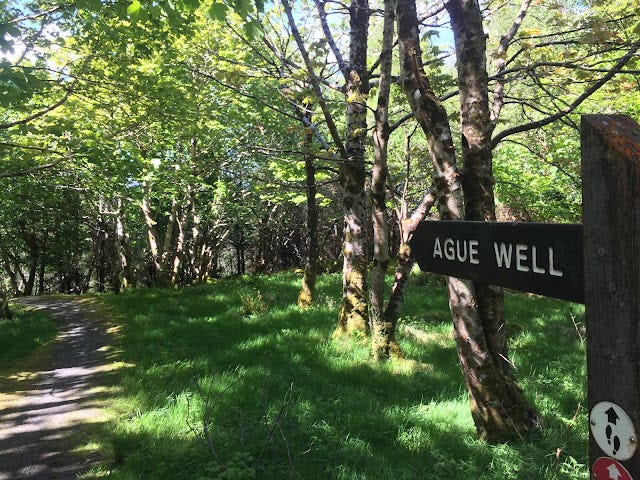
The neighbors I’ve asked about the well didn’t know what the name means. They are surprised to learn that malaria was once endemic here. The last malarial outbreaks in Ireland were in the mid-19th century. Globally, the suffering continues; malaria infects 200 million people a year.
I don’t know if the Auge Well ever cured malaria, but it’s a sacred site for everyone. I find offerings at the Auge Well, some obviously Catholic, some not. The Ague Well is a place that—like malaria—doesn’t care what your faith tradition is.
Another source on Dúchas.ie records that emigrants took Auge Well water with them because it cured homesickness. If I ever had to leave Ireland, I would definitely keep a bottle of its water on my altar. It would be a balm, as homesickness comes on like a fever, sharp and cyclical.
Traditionally, holy wells cured diseases of the mind and heart, as well as the body. An eye well might sooth eyes irritated by the smoke in a poorly ventilated cottage, but might also help the person see the resolution of a dispute.
A walk in nature, with intention, and formal words, said aloud for your own ears to hear: these actions can be self-transformational, the only true magic. You only have to believe in yourself.